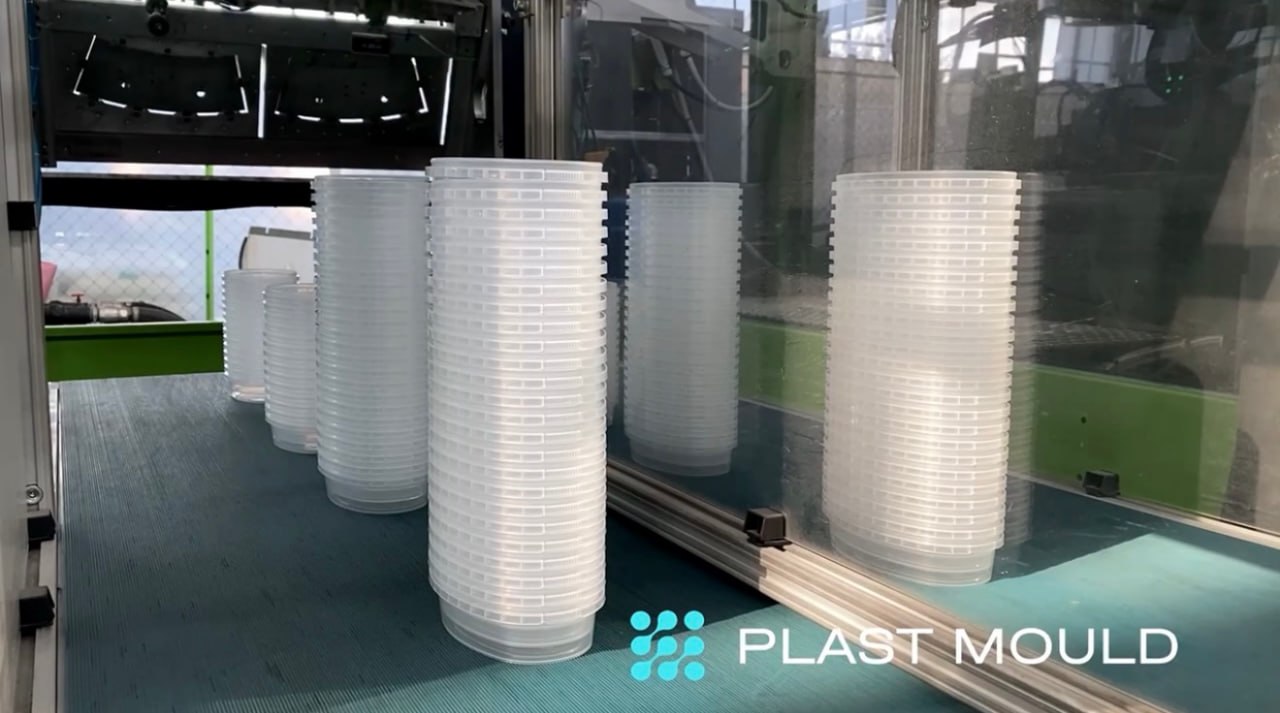
Stages of plastic packaging production
3 April, 2026Plastic Container Production: How Plastic Packaging is Manufactured
Modern plastic container production is a complex multi-stage technological process that combines engineering solutions, automated equipment, and strict control standards. To obtain high-quality plastic containers from a manufacturer, it is necessary to follow a clear sequence of actions — from raw material selection to final inspection of finished products. This is why plastic packaging manufacturing, with stages regulated by technical norms, requires deep expertise and a modern production base.
"Plast Mould" as a plastic packaging manufacturer operates according to industrial standards, where every stage of the process is critical for product quality, safety, and stability.
Plastic Product Manufacturing Technology: A General Approach
Plastic product manufacturing technology is based on the thermal and mechanical processing of polymers followed by the formation of a specified geometry. The production cycle includes material preparation, melting, molding, cooling, and finishing. Each of these stages requires precise adjustment of temperature, pressure, and time parameters.
In industrial environments, container manufacturing is carried out using high-performance equipment, allowing for the production of plastic cups, plastic buckets from the manufacturer, and other packaging formats with repeatable quality in large volumes.
Main Stages of Plastic Container Production
The plastic container production process consists of clearly defined technological stages, each of which directly affects the strength, airtightness, geometric stability, and safety of the finished product. The correctness of raw material preparation, equipment setup, and adherence to molding parameters determines not only the appearance of the container but also its suitability for food contact and long-term operation.
Key stages include:
- Raw material preparation — specialized food-grade plastic raw materials are used, undergoing cleaning, drying, and dosing for stable processing.
- Polymer molding — plastic granules are heated to a specified temperature and converted into a viscous-flow state for subsequent molding.
- Injection molding or thermoforming — the mass is fed into molds where the geometry of the future product is created according to technical specifications.
- Cooling and stabilization — the product is cooled to fix its shape and mechanical properties.
- Mechanical processing — trimming, calibration, and preparation for quality control.
Each of these stages is automated and controlled by modern sensor systems that track temperature, pressure, feed rate, and cooling parameters in real-time. This approach minimizes the human factor, reduces the risk of technological errors, and ensures the stability of serial production regardless of batch volumes. Automation is especially important for mass production, particularly when plastic cups from the manufacturer are produced, where repeatability of geometry, wall thickness, and edge fixation quality is critical for every item.
Equipment for Plastic Packaging Production
Modern equipment for plastic packaging production is the foundation of efficient and large-scale manufacturing. It includes injection molding machines and robotic systems for feeding and packaging. The technical capabilities of the equipment determine which product formats a plastic container manufacturer can produce and with what productivity. The use of automated lines allows for the simultaneous manufacture of plastic containers from the manufacturer, cups, lids, and buckets with high geometric precision and identical characteristics in every batch.
Quality Control in Plastic Manufacturing and Certification
Quality control in plastic manufacturing is a mandatory and integral part of the technological process, especially regarding food packaging. Inspections are carried out at all stages — from incoming raw material control to final testing of finished products before shipping. During the analysis, physical and mechanical characteristics, airtightness, compliance with geometric parameters, and material safety for food contact are evaluated. This approach allows for the timely detection of deviations and maintains high quality standards throughout the entire production cycle.
The control system includes:
- Visual inspection — checking the surface for defects and deformations.
- Mechanical testing — testing for strength, airtightness, and load resistance.
- Hygienic tests — confirming material safety for food contact.
- Quality control and certification — compliance with national and international standards.
Thanks to a multi-level control system, a plastic container manufacturer can guarantee consistent product quality regardless of the product's complexity or the scale of the order. Clearly established control processes, equipment automation, and standardization of technological operations allow for the building of a production facility with predictable quality parameters, ensuring identical product characteristics in both small and large series.
Container Manufacturing Technologies from the Manufacturer
Modern container manufacturing technologies focus not only on high equipment productivity but also on rational resource use, minimization of production waste, and ensuring stable result repeatability in every batch. Process automation, precise raw material dosing, and molding parameter control allow for cost reduction without loss of quality. This approach enables "Plast Mould" to remain competitive in the market and offer effective solutions for various industries — from the food industry to logistics, where containers are subject to increased requirements for strength, safety, and functionality.
Cooperation with Plast Mould
Understanding how plastic containers are manufactured allows one to appreciate the complexity and technological nature of this process. From proper raw material preparation to final quality control — every stage affects the safety and durability of the product. If you are looking for a reliable partner in the manufacturing sector, contact "Plast Mould." We offer a full cycle — from design to serial production of plastic packaging. Contact us today for a consultation and to order products directly from the manufacturer.