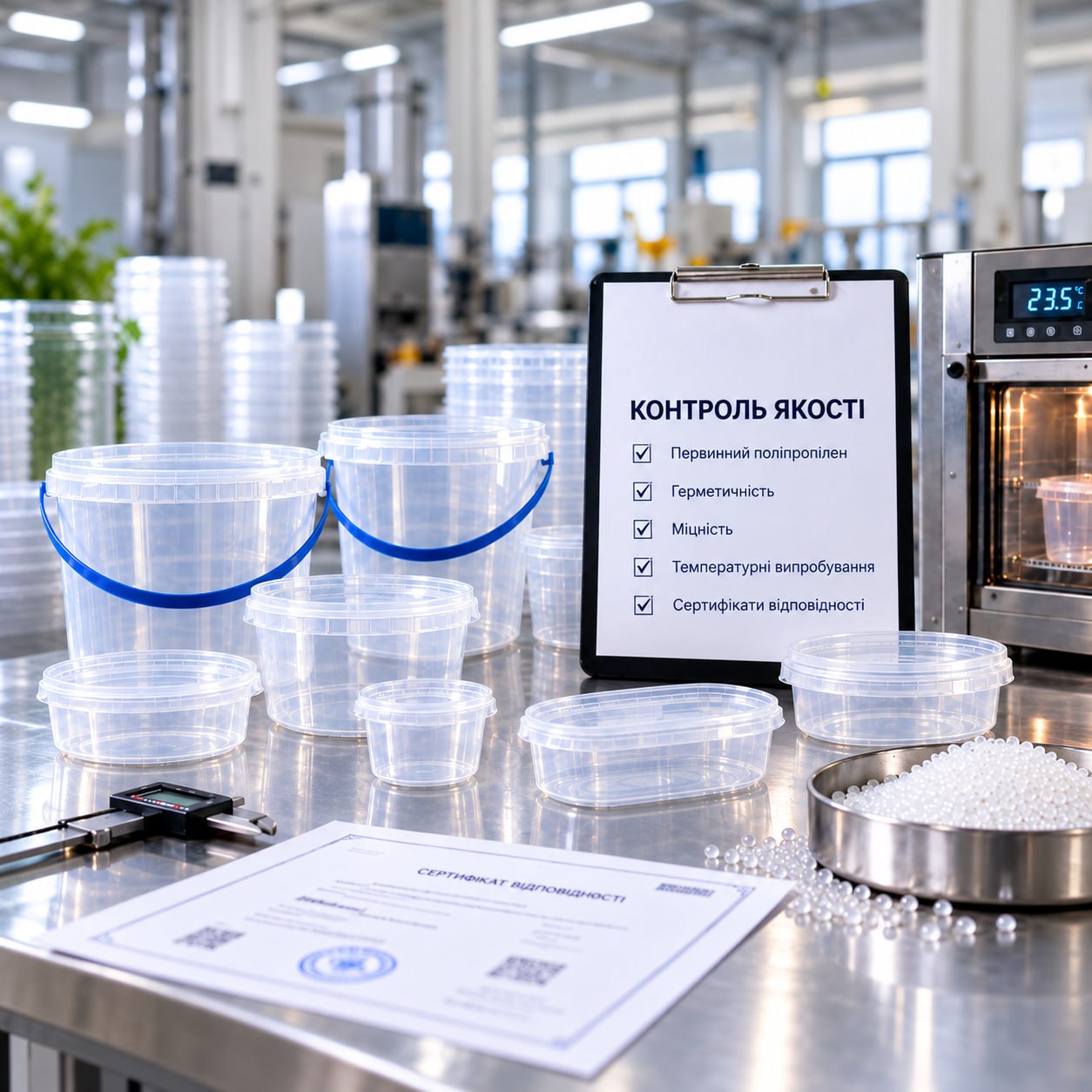
Food-Grade Plastic Packaging: Quality Control Methods at Plast Mould
26 October, 2026Food-grade plastic packaging comes into direct contact with food, so businesses in the food industry need to consider more than its shape, capacity or ease of filling. Material properties, leak tightness, mechanical strength and performance at different temperatures are equally important. This is why quality control of plastic packaging is part of the production process at Plast Mould. The company uses virgin raw materials, tests finished products and monitors the characteristics that determine how well packaging performs during filling, transportation and food storage.
Why plastic packaging quality control matters to the food industry
For food manufacturers, packaging is part of both the production and logistics chain. Plastic food packaging must withstand the loads associated with filling, closing, stacking and transportation. If a package loses its shape or does not close securely enough, problems may arise after the product has already been packed. Manufacturers therefore need to check packaging characteristics before supplying it to customers.
Consistent specifications are especially important in large batches, as food businesses use hundreds or thousands of packaging units rather than individual items. Plast Mould tests leak tightness, strength, stability and resistance to temperature exposure. This production approach helps assess characteristics that matter in practical use. The range of plastic packaging includes solutions for different filling and packing requirements.
Virgin polypropylene as the basis of safe food packaging
Material selection is a key consideration when producing plastic packaging intended for food contact. Plast Mould uses virgin polypropylene exclusively and does not use recycled raw materials. For B2B customers, this matters because the origin and consistency of the material are directly linked to predictable properties in the finished packaging.
Polypropylene food packaging is manufactured by injection moulding. During this process, material is injected into a mould, where the product takes on its specified shape. Plast Mould uses Engel and Demag equipment, with some operations automated by robotic manipulators. Process control is particularly important for a company that processes approximately 200 tonnes of polypropylene each month, given the scale of its serial production.
The use of virgin material is also an important part of assessing material safety. However, the suitability of any particular package should be evaluated as a whole, taking account of its intended purpose, characteristics and the manufacturer’s documentation. The plastic packaging manufacturing page explains the production process in more detail, from polypropylene processing to the finished product.
How Plast Mould tests plastic packaging for leak tightness and strength
Leak tightness is one of the characteristics Plast Mould checks in its finished products. The company conducts leak-tightness tests to assess this property before customers put the packaging into use. This is important for the food industry because packaging must pass through filling, closing, handling, storage and transportation stages.
Strength and stability are tested separately. Packaging can be exposed to mechanical loads during manufacturing and logistics, so its ability to retain its functional properties matters to the customer. Plast Mould performs the relevant tests rather than relying solely on the appearance of the finished product.
These characteristics are relevant to different packaging formats. For example, plastic containers may be used in filling operations where product geometry, closure performance and stability during subsequent handling are important. The combination of material properties and finished-product characteristics determines whether a particular format meets a company’s requirements.
Temperature testing: assessing packaging resistance
Food packaging is not always used under constant conditions. Products may be exposed to higher or lower temperatures at different stages, so Plast Mould conducts temperature tests on its packaging. These tests assess resistance to temperature exposure, including both high and low temperatures.
For B2B customers, these checks matter when selecting packaging for a particular production process. Food packaging should be chosen according to its actual intended conditions of use, rather than size and shape alone. Temperature resistance is therefore considered alongside leak tightness and strength as one of the finished-product properties monitored by the manufacturer.
The same applies to packaging formats intended for larger product volumes. Plast Mould offers plastic buckets in its catalogue, allowing businesses to consider the product being packed, filling requirements, storage conditions and subsequent transportation when making a selection.
Certificates of conformity for plastic food packaging
Food businesses need more than the packaging characteristics stated by the manufacturer: supporting documentation is also important. Plast Mould holds certificates of conformity for food-related products. This is an important consideration when working with B2B customers who must assess whether packaging is suitable for its intended application.
Certified plastic packaging therefore combines documentary evidence of conformity with production-stage checks of the product’s characteristics. Plast Mould does not focus on just one parameter: its approach includes virgin raw materials, injection moulding, leak-tightness, strength and stability testing, and assessments under different temperature conditions.
How production controls help maintain consistent quality across batches
In serial plastic packaging production, the goal is to maintain predictable characteristics across entire batches, not just in individual samples. Plast Mould processes approximately 200 tonnes of polypropylene each month, making production control essential to handling large volumes consistently. Engel and Demag equipment, together with the automation of certain operations using robotic manipulators, support the organisation of the production cycle.
Equipment, however, is only one part of the system. Consistent quality results from a combination of controlled raw materials, a well-managed manufacturing process and testing of finished packaging. Plast Mould uses virgin polypropylene exclusively, does not use recycled raw materials, and checks its products for leak tightness, strength, stability and resistance to high and low temperatures.
As a manufacturer of food-grade plastic packaging, Plast Mould therefore focuses its quality controls on characteristics that matter in real food-industry applications. For B2B customers, this makes it possible to select packaging based not only on capacity and design, but also on material, operating conditions and manufacturer-confirmed characteristics. This approach is particularly important where packaging consistency and quality control contribute to a reliable filling process.