How Plast Mould Manufactures Plastic Packaging: Injection Molding and Quality
18 August, 2026Plastic packaging production is not simply about pouring plastic into a mold. It is a precise technological process in which the raw materials, equipment, and quality control determine how reliable, safe, and consistent the finished packaging will be for the customer. Plast Mould is a plastic packaging manufacturer in Ukraine that carries out the entire production cycle at a single facility — from tooling development to the final inspection of finished products.
How Plastic Packaging Production Is Organized at Plast Mould
The production process begins with the selection of raw materials. Plast Mould is a plastic packaging manufacturer that uses exclusively virgin polypropylene — granules produced from primary raw material without previous recycling. Recycled raw materials are deliberately excluded from polypropylene packaging production. This is particularly important for food packaging, where contamination or an inconsistent chemical composition of the material is unacceptable.
Every month, the company processes approximately 200 tonnes of polypropylene across 5,000 m² of production facilities. These production capacities enable Plast Mould to handle large-volume orders within consistent lead times.
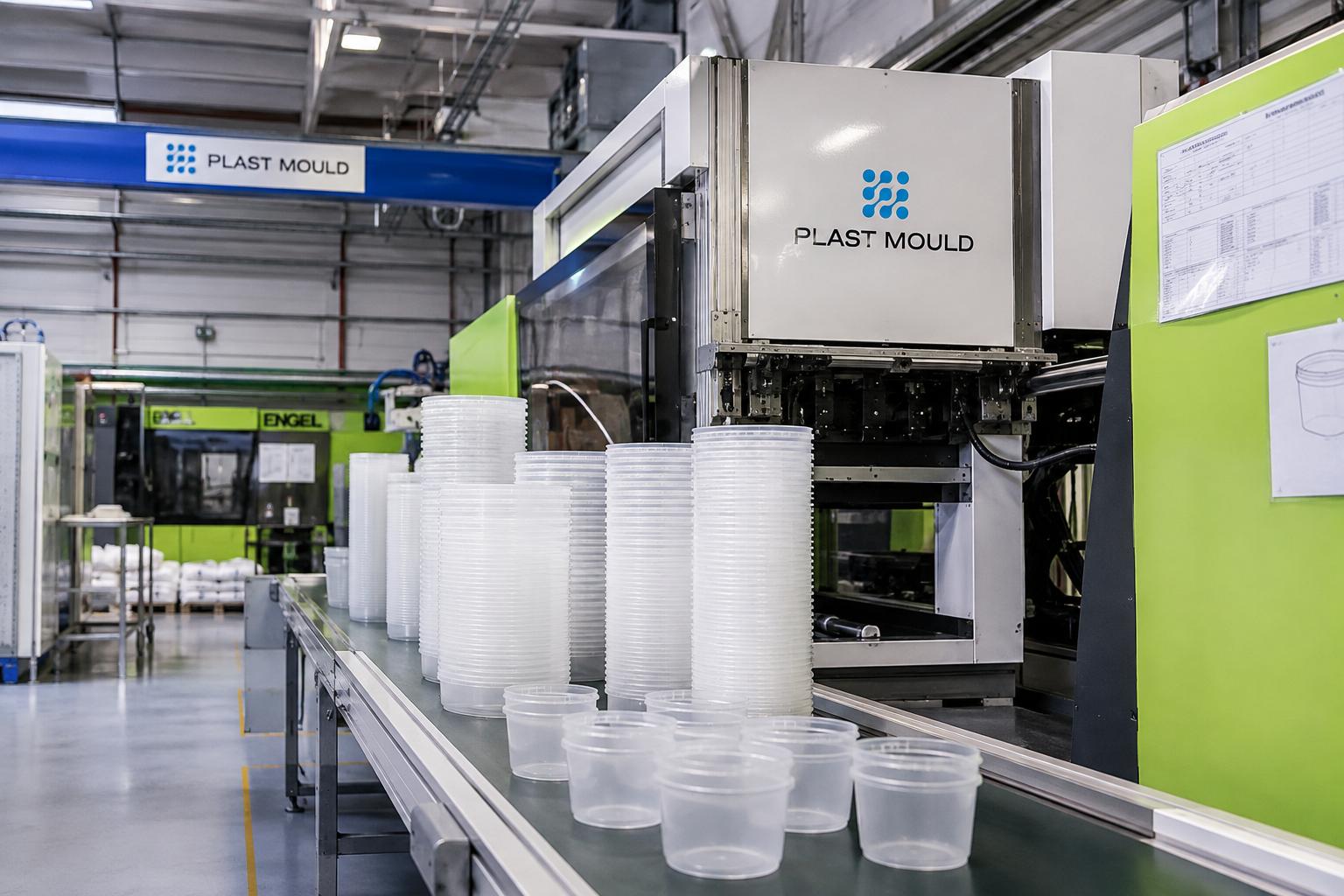
The main production method is injection molding (Injection Molding). Molten polypropylene is injected into a metal mold under high pressure, where it cools within seconds and takes on precise geometric dimensions. Plastic injection molding ensures repeatable accuracy and consistent wall thickness from one production batch to another — a key requirement for plastic packaging for food products.
Why Modern Equipment Affects the Quality of Plastic Packaging
The quality of plastic products directly depends on the precision and stability of injection molding machines. Plast Mould operates Engel equipment and Demag equipment — machinery designed to maintain stable process parameters throughout each injection molding cycle.
Engel and Demag machines provide precise control of melt pressure and temperature, helping to minimize defects and dimensional variations between products within the same production run. As a result, plastic containers from the manufacturer leave the production line with consistent characteristics — this is the standard rather than the exception.
Some production operations are automated using robotic manipulators. They remove finished products from the molds, place them onto conveyors, or transfer them directly to the next processing stage. Production automation reduces the influence of human factors during repetitive operations and helps maintain a consistent production cycle without unnecessary interruptions or deviations.
In-House Mold Manufacturing — One of Plast Mould's Competitive Advantages
Many manufacturers purchase ready-made molds or outsource their production to third-party contractors. Plast Mould has taken a different approach: the company operates its own metalworking workshop, where the complete mold manufacturing cycle is carried out — from design to milling and polishing.
In-house tooling provides significant advantages for customers:
- mold repairs are performed directly by the company without dependence on external contractors;
- changes to product design can be implemented quickly — without weeks of waiting;
- tooling quality is controlled at every stage, which directly affects the dimensional consistency of finished products.
Having its own tooling workshop also means that the company can respond to customers' technical requirements — modifying geometry, adding structural elements, and adjusting lid fit — without relying on external tooling manufacturers. More information about mold manufacturing is available on the production page.
Quality Control at Every Stage of Production
Plastic packaging quality control at Plast Mould is carried out at several levels. Incoming inspection checks the quality of raw materials before they are loaded into the machines, while operators monitor the parameters of each cycle throughout the production process.
Finished products undergo mandatory testing:
- leak testing — lids and containers are checked to ensure there are no leaks;
- strength testing — products are tested under loads corresponding to real transportation and storage conditions;
- resistance to temperature fluctuations — food-grade plastic packaging from Plast Mould is tested for resistance to low temperatures (freezing) as well as stability when in contact with hot food products.
The products are supplied with certificates of conformity for the food industry, confirming the safety of the material and its compliance with applicable requirements. For customers, this means that plastic packaging can be used for food packaging without requiring additional material certification on the customer's side.
Plast Mould's Production Capabilities for B2B Customers
The company focuses on working with businesses that require polypropylene packaging in stable production runs. More than 5,000 m² of production space and a processing capacity of approximately 200 tonnes of polypropylene per month enable the company to fulfill large-volume orders without unnecessarily extended lead times.
Customers also have access to a wide range of customization options:
- a wide range of colors — products can be manufactured in the required corporate color;
- adjustable material transparency — from fully transparent to opaque;
- IML labels — in-mold labeling is available for selected products. With this technology, the decorative label is integrated directly into the product during the molding process, providing resistance to moisture and mechanical impact.
Customers can explore plastic containers and other packaging formats on the manufacturer's website to select a suitable product or submit a request for custom plastic packaging production.