How to Choose Plastic Containers for Product Packaging: Shape, Capacity and Lid Type
23 November, 2026When choosing plastic containers for packaging, a business should consider more than their appearance. It matters how the product fills the container, whether it is easy to dispense and whether the packaging can withstand distribution conditions. Choosing the wrong shape or capacity affects costs, packing speed and customer convenience. Start with the properties of the product, then compare the available container models.
Which Parameters Should You Consider First?
Before looking for containers for product packaging, determine the weight of each portion, the filling method and storage requirements. Then match the product's characteristics to the sales format and the capabilities of your filling equipment. Buyers should also consider label space, container height on the shelf and placement in shipping cartons. Separate essential requirements from preferences so that samples can be compared on equal terms. Record any limitations, including filling temperature, suitability for contact with the product and how the end customer will open the container.
How to Account for Product Properties and Sales Format
Thick paste, liquid sauce and dry mixtures behave differently during filling. For viscous products, assess the opening width and how easily the contents can be removed completely. Fine particles must not spill, while liquid products require a closed container that remains secure when tilted. The sales format also matters: a single serving, repeated use or wholesale supply. Products consumed gradually need packaging that can be closed again conveniently. Each scenario calls for suitable packaging, and its performance should be tested with the actual product.
Round, Square, Oval and Rectangular Containers: Practical Differences
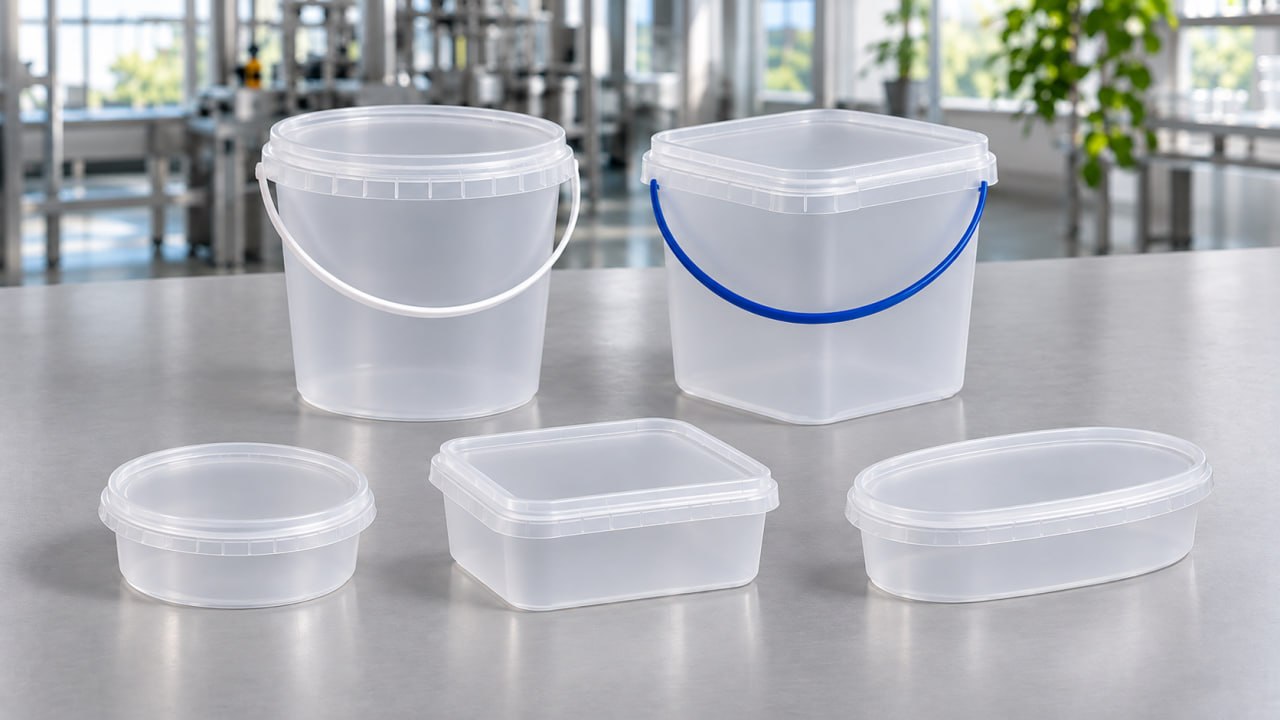
When comparing plastic container shapes, consider both usability and packing efficiency. Round containers have no corners, making thick contents easier to remove. Square and rectangular designs may help fill shipping cartons more efficiently, depending on their external dimensions. Assess oval containers for label area and ease of handling. Compare height and width together: a narrow container may not be sufficiently stable on a conveyor.
If efficient storage is the priority, compare external dimensions rather than outlines alone. When choosing plastic containers, check the available label area and the number of units that fit into a shipping carton. For square and rectangular models, account for rounded corners; for round ones, consider the gaps between units. The ability to nest empty containers affects warehouse space requirements. Stability when filled is also important during transportation.
How to Calculate the Required Plastic Container Capacity
A plastic container's nominal capacity does not automatically equal the amount of product it can hold during filling. Begin with the portion weight and the actual density of the contents. For dry mixtures, bulk density matters and varies with particle size and compaction. Consequently, the same weight of different products can occupy different volumes. Verify the calculated value using the actual product before choosing a container size. Do not use the volume of water as a universal reference for pastes, granules or flakes.
Usable Capacity, Headspace and Fill Weight
Actual usable capacity is determined by the fill level, not simply by the volume printed on the container. For example, a 300 g portion with a density of 1.2 g/ml occupies approximately 250 ml. This is an illustrative calculation, not a ready-made capacity recommendation. Leave sufficient headspace between the contents and the lid for proper closing. Determine the required clearance through trial filling. If the mixture settles or foams, check the fill level under real production conditions.
How to Choose a Lid and Check Closure Performance
Even a well-chosen container body will not perform properly without a compatible lid. When choosing plastic containers with lids, check the fastening method and whether they can be reopened. The selected lid type must suit the closing process and the product's intended use. Test closure performance on a filled container, not just an empty sample. A snug fit alone does not establish a leakproof seal, so the testing criteria should be agreed separately.
When selecting a lid, examine the locking mechanism, container rim and ease of opening for customers. For products used more than once, the lid must retain an effective fit after repeated closing. If tamper evidence is required, confirm that the specific model has an appropriate feature. A tamper-evident element is not proof of leak resistance: these properties must be assessed separately.
What to Check Before Placing a Wholesale Order
Before placing a wholesale order, obtain a container sample and test it at the filling, labelling and packing stages. Assess consistency across several samples rather than relying on a single unit. If the product will also be sold in larger packs, compare plastic buckets as a separate packaging option. Consider how the larger container will be carried, the weight of the filled package and ease of use. Record the test results before agreeing on supply quantities.
During the trial run, record the following container acceptance criteria:
- Fill weight and fill level — the required portion must fit without contaminating the lid's sealing rim;
- Body and lid stability — the packaging must retain its shape during the intended stacking and handling operations;
- Compatibility with the line and labelling — check container feeding, the closing station and available label space;
- Dimensional consistency — compare several samples for dimensions and closing force rather than relying on one successful unit.
After testing, record the body part number, compatible lid, permissible tolerances and acceptance criteria. Every batch should match the approved sample in dimensions, lid fit and behaviour during filling. A change in even one parameter may require adjustments to the production line. A written specification makes repeat orders easier and helps distinguish packaging defects from equipment setup problems