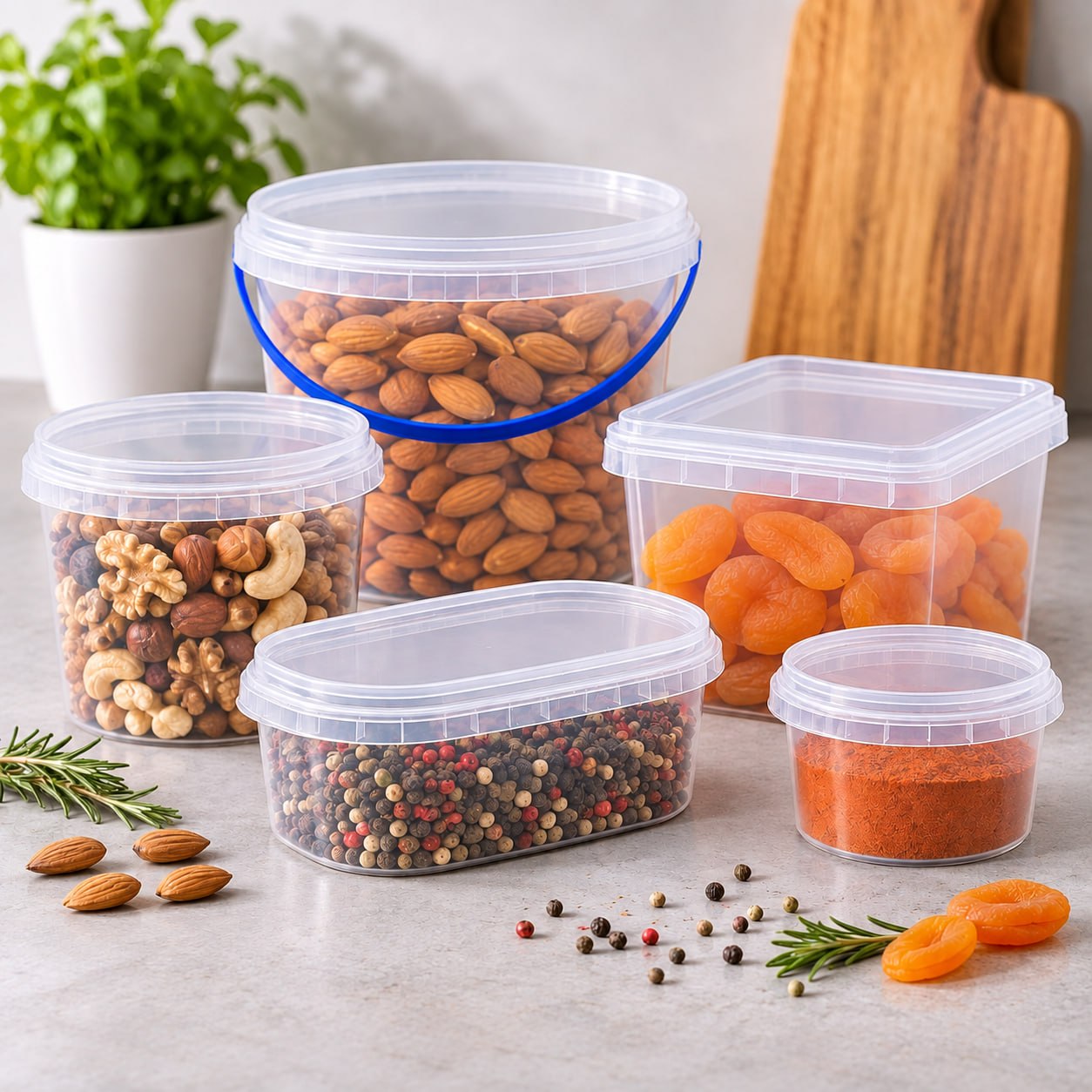
How to Choose Packaging for Dry Foods: Nuts, Dried Fruit, Spices and Mixes
23 November, 2026For packers, packaging for dry foods must suit not only the portion weight but also how the contents behave during storage and sale. Nuts can release oils, dried fruit can be sticky, and spices readily create dust and transfer aromas. Therefore, containers that look alike are not necessarily suitable for different products. Before choosing, identify the properties of the batch, how the pack will be opened and the transport requirements. This helps prevent product loss and unnecessary repacking costs.
Which Properties of Dry Products Affect Packaging Choice?
Start with the characteristics of the product itself. Plastic packaging for dry foods must account for particle size, how freely the mixture flows and the dispensing method. Whole nuts, sticky dried fruit and fine powders fill containers differently and behave differently around the lid. For each product, define the portion weight, required opening width and intended use after purchase. If the package will be opened repeatedly, convenient access to the contents matters. Record these requirements before selecting a particular model.
Moisture, Aroma, Particle Size and Caking Risk
Moisture protection matters for products that absorb water from the air and may cake. If a mixture contains aromatic compounds, assess not only the lid fit but also the material's barrier properties over the intended shelf life. Particle size determines whether powder will settle into gaps or spill when opened. For mixed products, check whether the contents separate after handling. Material and design choices should be supported by the product manufacturer's requirements rather than general promises of 'complete airtightness'.
Which Packaging Format Works for Nuts and Dried Fruit?
Containers for nuts should be selected according to nut size, fill weight and display conditions. Whole almonds or walnuts require a sufficiently wide opening so they can be filled without damage. For chopped mixes, consistent dispensing and a clean sealing rim matter more. When selecting plastic containers, compare external dimensions with capacity, available label area and arrangement in a shipping carton. Confirm separately that the specific packaging is suitable for food contact.
Packaging for dried fruit calls for a different approach: sticky fruit can become compressed, while large pieces make narrow containers harder to fill. A wide opening makes it easier to pack and remove the product without excessive squeezing. For mixed assortments, account for uneven placement and empty spaces between pieces. Unlike dried fruit, fine spices and powders place special demands on the closure area. That is why these product groups should not all use the same packaging selection criteria.
Packaging Considerations for Spices, Powders and Fine Mixtures
Packaging for spices should minimise the loss of fine particles during dispensing, closing and use. Powders may remain on threads or sealing rims, so assess the opening shape and access for cleaning. For aromatic mixes, retaining the scent under specified conditions matters, but a lid alone does not guarantee the required barrier. Also check how the filling equipment handles light particles and whether dust forms around the capping station. Tests should use the actual finished formulation.
How to Prevent Spillage and Aroma Loss
Closure tightness should be assessed on a filled sample after normal handling and repeated opening. For powders, it is especially important that particles do not reach the lid's contact surface. Aroma can escape even without visible spillage, so material barrier requirements must be agreed separately. Check whether unwanted odours transfer between products stored together. If necessary, choose another form of internal protection, but verify its compatibility with the container through testing.
How to Match Fill Weight to Container Volume and Shape
Convert fill weight to volume using the product's bulk density, which varies between products. As an illustrative example, 300 g of a mix with a bulk density of 0.6 g/ml occupies about 500 ml. The formula is simple: divide weight by bulk density. This is not a final capacity recommendation, since headspace is needed and the contents may settle. Container geometry also affects stability and placement in shipping cartons. Check the calculation against an actual portion before choosing a container.
If larger batches are planned, consider plastic buckets with appropriately designed lids as a separate option. Ease of carrying matters for heavy packages, while reusability is important for smaller portions. However, nominal capacity is not the same as usable volume when the product requires free space above its surface. Before ordering, measure the actual fill height and make sure the rim stays clean. Do not apply calculations from one mixture to another without checking.
What to Check Before Packing, Storage and Transport
Before purchasing, assess food containers using material documentation and suitability for the specific contents. Confirm whether the chosen material is approved for food contact, and agree on labelling and storage conditions. Fatty nuts and aromatic mixtures may require different conditions even at the same portion weight. Also determine how units will be arranged in shipping cartons and the allowable load on the packaging. The final check should therefore cover delivery and storage rather than repeat the choice of container shape.
Before approving a purchase, check the following:
- Fill weight and level — the portion does not obstruct the lid or contaminate the sealing rim;
- Closure — the lid fits the body and prevents visible spillage under agreed conditions;
- Labelling — the label fits on an accessible surface and remains legible;
- Transport — filled units remain stable in shipping cartons and do not deform under normal stacking.
In the supplier specification, record the body part number, compatible lid, number of units per carton and batch acceptance criteria. Specify separately which changes to the formulation or fill weight require packaging approval again. Confirm who is responsible for material documentation and who verifies the finished container's parameters. Dividing these responsibilities makes repeat orders easier and reduces differences between approved samples and production deliveries. Agree on all conditions before placing a wholesale order